

The Stablex Case in Blainville: Full Investigation, Cell No. 6 Expansion, and International Proceeding
From the opening of the hazardous waste landfill in 1983 to the expropriation under Bill 93 and citizen submission SEM-26-003 before the Commission for Environmental Cooperation (CEC): the independent, verified documentary analysis of the largest environmental justice case in the Lower Laurentians.
1. What is Stablex?
Located at 760 boulevard Industriel in Blainville, the Stablex industrial installation was commissioned in 1983, at a time when Quebec environmental standards and hydrological knowledge of peat wetlands were embryonic. The plant mainly receives liquid, pasty and solid inorganic hazardous materials: metal surface treatment sludge, mining residues, incineration ashes, contaminated soil and industrial waste with a high concentration of heavy metals (cadmium, lead, nickel, copper, arsenic, chromium).
The operating principle is based on an alkaline reaction: liquid or muddy waste is neutralized, mixed with chemical additives, then amalgamated with binding agents based on lime and Portland cement. The resulting paste, commercially called “Stablex,” is pumped and dumped into gigantic landfill basins called cells. As the mixture hardens, it forms a matrix that is supposed to chemically and physically trap pollutants to prevent them from leaching into ground and surface water.
However, scientific and citizen criticisms formulated over four decades of exploitation point to the long-term geochemical degradation of this material under the action of the natural acidity of the peatlands (acid pH between 3.5 and 4.5), northern freeze-thaw cycles and rainwater infiltration, calling into question the perpetual impermeability promised by the developer.
2. Who owns Stablex? Ownership structure and multinationals
Contrary to a widespread perception that Stablex is a local Quebec company, its share capital and decision-making power are entirely controlled from abroad. After belonging to the British Hanson group, then to the American Waste Services group, Stablex was integrated into US Ecology Inc. In May 2022, Republic Services Inc., listed on the New York Stock Exchange and with a market capitalization of several tens of billions of dollars, completed the complete acquisition of US Ecology.
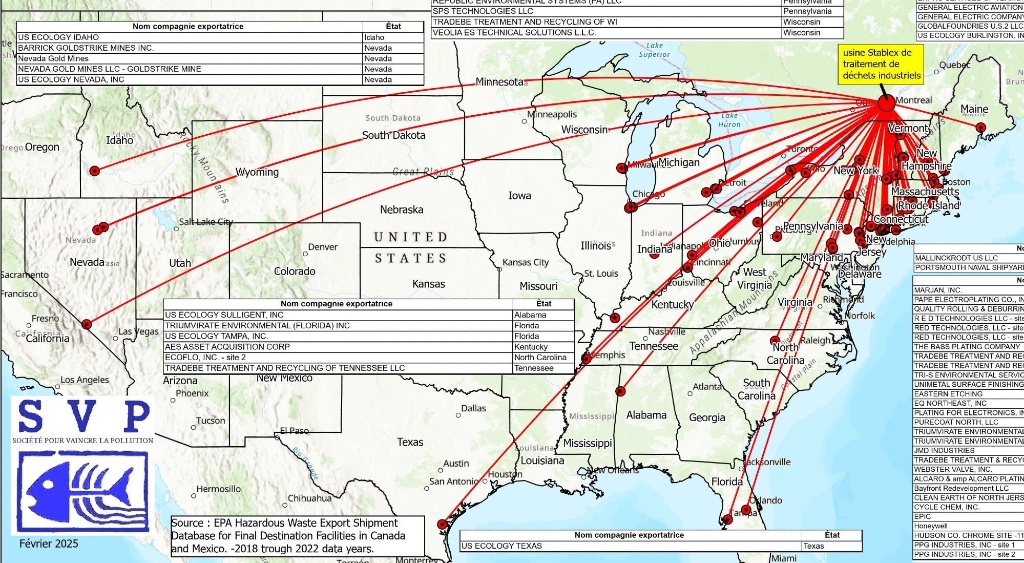
This membership of a leading American conglomerate sheds light on a fundamental aspect of the economic model of the Blainville site: the massive importation of American hazardous waste. Under the Canada-United States Agreement Concerning Transboundary Movements of Hazardous Wastes (1986) and the Basel Convention, tens of thousands of tonnes of highly toxic waste from plants in New England, New York and the US Midwest cross the border each year to be stabilized and buried in perpetuity in Blainville.
According to the briefs submitted during the public hearings, more than 50% of certain categories of treated waste come directly from the United States, transforming the municipality of Blainville and the Grande Tourbière (Great Peat Bog) into a receptacle for cross-border industrial hazardous materials.
3. Cell No. 6: The expansion project in Grande Tourbière
What do 278,000 m² of threatened peatland represent in concrete terms?
The encroachment of Cell No. 6 is equivalent to razing a continuous surface of 183 ice rinks at the Bell Center in the heart of a thousand-year-old, non-replaceable ombrotrophic bog.
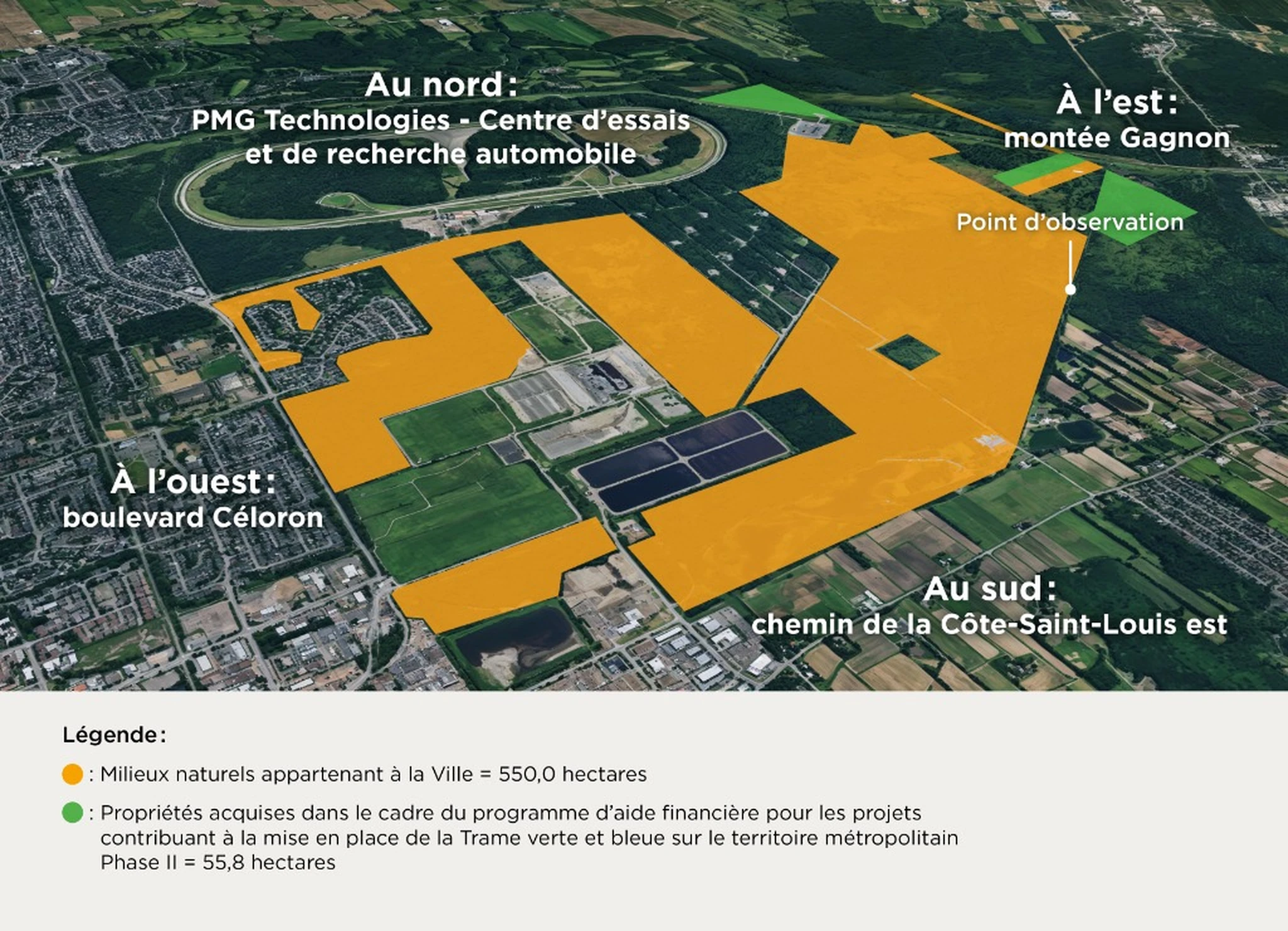
Since 1983, Stablex has operated and successively filled five landfill cells (cells 1, 2, 3, 4 and 5). Faced with the foreseeable exhaustion of the residual capacity of cell no. 5 by 2025-2026, the company has submitted a vast expansion project: cell no. 6.
This project involves the development of a gigantic new pit of 27.8 hectares to the southeast of the existing facilities. The major problem lies in its geographical base: the targeted land is entirely composed of ombrotrophic peat bogs (bogs) and mature wooded wetlands forming the nerve center of the Grande Tourbière de Blainville (Great Blainville Peat Bog), one of the last large intact peat complexes in the Montreal metropolitan region.
The construction of cell no. 6 involves drainage, felling trees, excavating several meters of organic matter accumulated over 8,000 years and installing a geosynthetic waterproofing membrane. This mechanical destruction wipes out a major carbon sink capable of sequestering thousands of tons of CO₂ and destroys the vital habitat of wildlife and plant species designated as threatened or vulnerable, such as the milk snake, monarch butterfly, snapping turtle and western chorus frog.
4. The report BAPE 371: The unfavorable opinion of the State experts
Following the public hearings held in fall 2020, the BAPE (Québec Bureau of Public Environmental Hearings) commission of inquiry analyzed more than a hundred briefs from experts, citizens, environmental organizations (Centre québécois du droit de l'environnement - CQDE, SNAP Québec (Society for Nature and Parks) - SNAP Québec) and municipal representatives.
Official report no. 371, submitted to the Quebec Minister of the Environment, formulated a resounding disavowal for the promoter:
- Irreplaceable ecological value: The Grande Tourbière de Blainville is recognized as an ecosystem of exceptional interest whose hydrological, microclimatic and natural water filtering functions cannot be artificially recreated through financial compensation.
- Lack of alternative location efforts: The BAPE severely criticized the company for not having looked for degraded industrial sites or anthropized land outside the peatland zone to establish its new cell.
- Incompatibility of use: The permanent burial of dangerous materials in an environment saturated with water and linked to the regional water table presents disproportionate hydrological risks.
Based on these clear conclusions, Ville de Blainville (City of Blainville), owner of the targeted forest lots, formally refused to transfer its land to Stablex and adopted a strict policy of conservation of its natural heritage.
5. The Loi 93: Forced expropriation by exceptional legislative decree
Faced with the categorical refusal of the Ville de Blainville to sell its land and the regulatory blockage resulting from the BAPE 371 report, the government of Quebec chose to bypass the common law of land use planning by filing the Projet de loi 93 (entitled An Act concerning the project to expand the Stablex Canada Inc. hazardous materials landfill in Blainville).
This direct political intervention sparked a democratic shock wave across the province:
- Forced expropriation of a municipality: The law orders the transfer of municipal property titles to the private company without the agreement of the City, creating an alarming precedent for the autonomy of Quebec's 1,100 municipalities.
- Adoption under gag order: The parliamentary debates were brutally interrupted by the executive to force the text to be adopted on March 28, 2025, ignoring the protests of the opposition parties, the Union des municipalités du Québec (UMQ) and environmental law lawyers.
- Judicialization of the conflict: The Ville de Blainville immediately challenged the constitutional validity of the law before the courts, denouncing an abuse of legislative power motivated by the corporate interests of an American multinational.
6. Water contamination analyzes and company position
The question of leachate leaks and the migration of contaminants out of the historic Stablex cells constitutes the most burning scientific element of the file. While the developer touts the durability of its solidification process, surface and groundwater samples have documented serious chemical anomalies:
| Parameter analyzed | Aquatic life standard (chronic) | Measurement observed downstream (Dec. 2023) | Overrun ratio |
|---|---|---|---|
| Cadmium (Cd) | 0.00025 mg/L | 0.080 mg/L | 320× standard |
| Zinc (Zn) | 0.030 mg/L | 0.420 mg/L | 14× the standard |
| Sulfates (SO₄) | 128 mg/L | 760 mg/L | 6× the norm |
The independent hydrogeological study carried out in June 2026 by the specialist firm WaterShed Monitoring highlighted the vulnerability of the local hydrographic network. The surface water of the sector flows towards the tributary network of the Mille Îles River and crosses the redeveloped gravel pits of Fauvel Lakes, a municipal recreational-ecological park very frequented by the citizens of Blainville.
The official position of Stablex Canada Inc.: The company categorically rejects responsibility for these excesses. In its briefs and public statements, Stablex states:
- That its facilities operate in strict compliance with the Regulation on the landfilling and incineration of dangerous materials (REIMD) and its environmental authorization certificate issued by the MELCCFP (Québec Ministry of the Environment, the Fight against Climate Change, Wildlife and Parks);
- That its network of regulatory monitoring piezometers does not record any indication of membrane breakage or significant percolation;
- That the heavy metals measured in the peripheral ditches could come from the regional industrial past (old Plan Bouchard embankments) or from the natural geological background of local sediments.
This fundamental divergence between independent data and industry declarations is precisely the heart of the reasons which justified the referral to international authorities.
7. The international appeal CCE SEM-26-003 before the ACEUM
Faced with the Quebec political impasse created by Loi 93, an international citizen legal recourse was initiated under Chapter 24 (Environment) of the Canada-United States-Mexico Agreement (ACEUM). William Guindon, a 15-year-old citizen of Blainville, submitted an official documented submission of more than 200 pages and supported by 222 public evidentiary documents.
The communication cites the failure to apply two fundamental laws of the Canadian Parliament:
- The Fisheries Act (L.R.C. 1985, c. F-14): In particular sections 34.4, 35 and 36(3), which formally prohibit the deposit of harmful substances in waters where fish live or in a place where these substances risk entering these waters. The hydrological connections between the peatland and the fish-bearing waterways are at the center of the complaint.
- Endangered Species Act (SARA, S.C. 2002, c. 29): The Cell No. 6 project encroaches on documented critical habitat of threatened species without a valid federal environmental impact permit.
On August 17, 2026, the CCE (Commission for Environmental Cooperation) Secretariat made its official determination under section 24.27(2) and (3) of the ACEUM (Canada–United States–Mexico Agreement), concluding that the citizen communication meets all strict legal criteria and requiring the Government of Canada to provide a formal written response by October 16, 2026. William Guindon on this occasion became the first minor author in the history of the SEM mechanism since its establishment in 1994.
The ultimate challenge of this procedure is the development of an independent international factual file publicly exposing in the eyes of the three member countries of the ACEUM the environmental protection flaws surrounding the Stablex file.
Consult the Official Register CCE SEM-26-003 ↗ Explore the 222 evidentiary documents ↗
8. Frequently asked questions (FAQ) about the Stablex file
What is Stablex and where is the factory located?
Stablex Canada Inc. is an industrial hazardous waste treatment and landfill plant located at 760 boulevard Industriel in Blainville, Quebec. Active since 1983, it neutralizes and solidifies inorganic chemical sludge by adding lime and cement before burying it in waterproofed pits adjacent to the Grande Tourbière de Blainville.
Who owns the Stablex company?
The company is a 100% subsidiary of the American group US Ecology, itself purchased in May 2022 by the giant Republic Services (NYSE: RSG) for 2.2 billion USD. More than 50% of hazardous materials processed on site are imported from the United States via the rail and road network.
Why is the Cell No. 6 project so contested?
Cell No. 6 provides for the burial of 1.7 million tonnes of stabilized waste over 278,000 m² (27.8 hectares) directly excavated in the Grande Tourbière de Blainville. This project destroys an irreplaceable ombrotrophic wetland and the habitat of threatened species, in contradiction with the expert opinion of BAPE 371.
What is the Loi 93 adopted on March 28, 2025?
The Loi 93 is an exceptional law adopted under gag order by the Assemblée nationale du Québec (National Assembly of Québec). She orders the forced expropriation of land belonging to Ville de Blainville to hand it over to Stablex, thus circumventing the democratic refusal of the municipal council and the unfavorable opinion of BAPE.
What are the contamination levels measured around the site?
Independent sampling from December 2023 revealed cadmium concentrations up to 320 times higher than provincial criteria for the protection of aquatic life in drainage ditches, corroborated by the WaterShed Monitoring study from June 2026. Stablex disputes any leak and claims to respect its ministerial authorizations.
What is the scope of the SEM-26-003 appeal to CCE?
The citizen communication SEM-26-003 filed by William Guindon before the Commission de coopération environnementale (CCE / ACEUM) aims to establish the failure to apply the Fisheries Act and the Species at Risk Act by Canada. The Canadian government must submit its official response by October 16, 2026.