

Structural adultism & Civic capacity of minors
Scientific declaration of support subscribed in Berlin on October 14, 2026 by Prof. Dr. Manfred Liebel and Philip Meade, M.A. in support of William Guindon (SEM-26-003) and the process of Petition e-7834 to the House of Commons of Canada.
Déclaration d'appui scientifique international (Berlin, October 14, 2026)
On October 14, 2026, an official declaration of scientific support was signed in Berlin by Prof. Dr. Manfred Liebel (professor emeritus of sociology at the Technische Universität Berlin) and Philip Meade, M.A. (Fachhochschule Potsdam / Alice Salomon Hochschule Berlin), co-authors of the reference treatise Adultism: A Critical Introduction to Discrimination Against Children (2026).
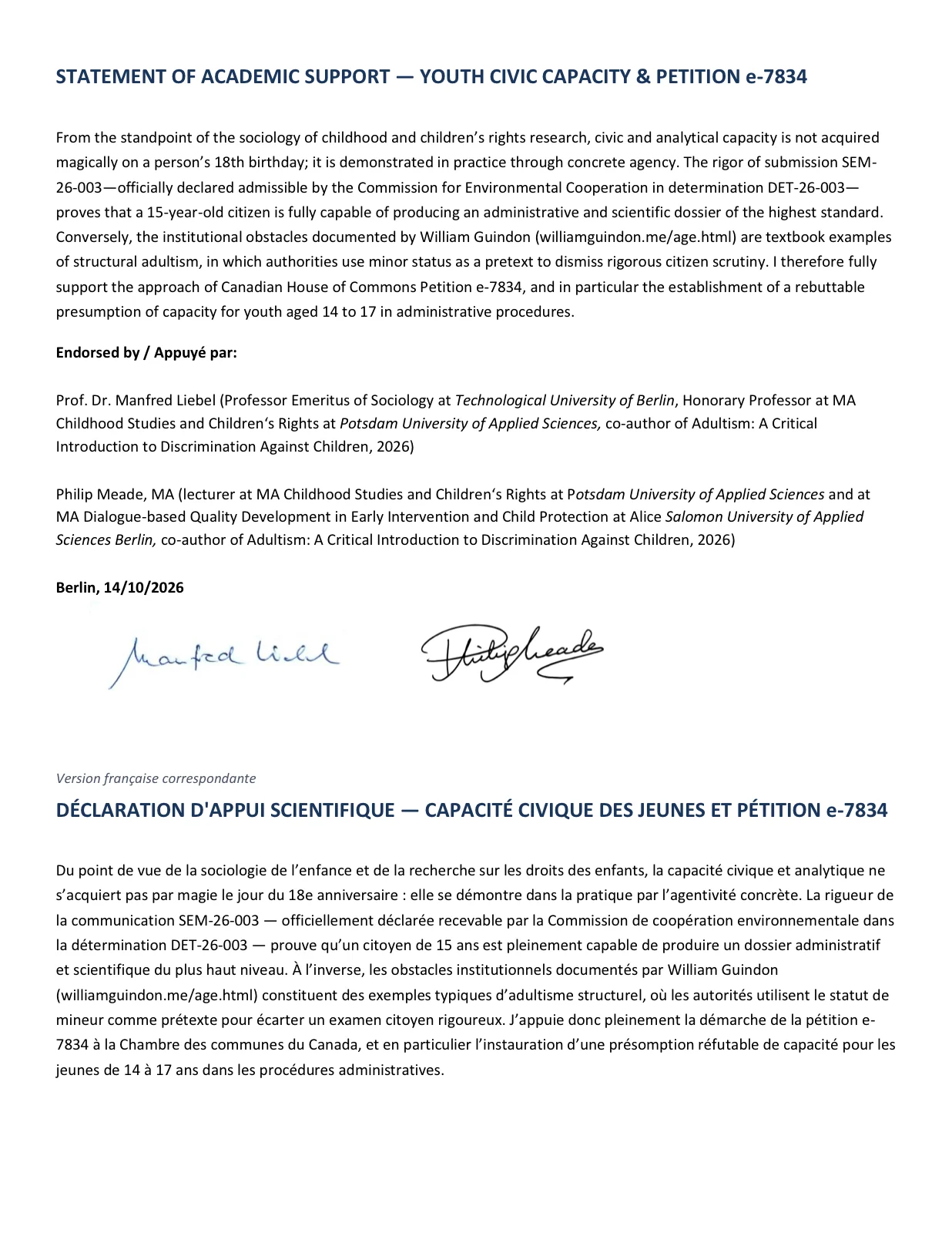
Certified autograph signatures (Berlin):

1. Official full declaration (Bilingual)
Subscribed in Berlin on Wednesday October 14, 2026 (48 hours before the federal deadline of October 16). Switch between the certified French version, the original English text or the comparative view:
STATEMENT OF SCIENTIFIC SUPPORT — YOUTH CIVIC CAPACITY AND PETITION e-7834
Traduction française certifiée“From the perspective of the sociology of childhood and children's rights research, civic and analytical capacity is not acquired by magic on the day of the 18th birthday: it is demonstrated in practice through concrete agency. The rigor of the communication SEM-26-003 — officially declared admissible by the Commission de coopération environnementale (Commission for Environmental Cooperation) in the determination DET-26-003 — proves that a 15-year-old citizen is fully capable of producing an administrative and scientific file of the highest level. Conversely, the institutional barriers documented by William Guindon (williamguindon.me/age.html) constitute typical examples of structural adultism, where authorities use minor status as a pretext to ward off rigorous citizen scrutiny. I therefore fully support the approach of petition e-7834 to the House of Commons of Canada, and in particular the establishment of a rebuttable presumption of capacity for young people aged 14 to 17 in administrative procedures. » ↗
- Prof. Dr. Manfred Liebel (Emeritus Professor of Sociology at the Technische Universität Berlin, Honorary Professor at the Master MACR at the University of Applied Sciences Potsdam, co-author of Adultism: A Critical Introduction to Discrimination Against Children, 2026).
- Philip Meade, M.A. (Lecturer of the MACR Masters at the University of Applied Sciences Potsdam and the Alice Salomon University of Berlin, co-author of Adultism: A Critical Introduction to Discrimination Against Children, 2026).
2. Conceptual insight: From ageism to structural adultism
In the media space and everyday language, any discrimination based on age is often described as “ageism”. In contemporary sociological research on children's rights, this term is insufficient:
Why “ageism” is reductive
The word “ageism” refers to interpersonal stereotypes or aging. It obscures the political, institutional and legal dimension of the subordination of young people.
Adultism
Defined by Liebel and Meade (2026), adultism designates a relationship of systemic domination by which adults arrogate discretionary power over minors and systematically presume their civic incapacity.
Structural adultism in administrative law
It is expressed when administrations establish the civil age as an end of inadmissibility: refusal of access to public documents, refusal to respond on the technical merits, or infantilization during public hearings.
Concrete Agency
The ability demonstrated in the field by a young citizen to investigate, analyze complex technical data and obtain a historic decision before the CCE (ACEUM) shatters the theoretical presumption of incompetence.
3. Petition e-7834 to the House of Commons of Canada
Petition e-7834 to the House of Commons assembled in Parliament
Official text submitted to the House of Commons:
- Whereas section 15(1) of the Canadian Charter guarantees everyone the same protection and equal benefit of the law, without discrimination based on age;
- Whereas article 12 of the Convention on the Rights of the Child, ratified by Canada, requires that the opinion of the discerning child be heard and considered according to his age and maturity in administrative procedures;
- Whereas the Code civil du Québec (Civil Code of Québec) allows minors aged 14 and over to consent alone to certain care, under the conditions of articles 14 and 17;
- Whereas Canada currently has no federal legal framework or independent commissioner to protect young people against administrative and institutional paternalism;
- Whereas automatically presuming the incapacity of young people aged 14 to 17 in their civic and administrative activities contravenes their intellectual integrity and may constitute discrimination.
- To adopt, within its areas of jurisdiction, a framework law against ageism and paternalism in services and institutions, public or private, under federal jurisdiction, and to negotiate a pan-Canadian agreement;
- To create an independent Federal Youth Commissioner (ombudsman), accessible to young people, responsible for receiving complaints and investigating federal institutions;
- To establish, for young people aged 14 to 17, an automatic and rebuttable presumption of capacity to participate in administrative decisions concerning them, reversible only after an individualized assessment of their age, maturity and competence, never on age alone, with written reasons, respect for autonomy and the right to be heard.
Épreuve des faits : Chronologie des démarches de parrainage (octobre 2026)
Factual Documentary FileOn the official electronic petition portal of the House of Commons (NosCommunes), a citizen petition must be authorized by a Member of Parliament before being published and open to public signatures. Without this formal sponsorship, the procedure remains blocked. In accordance with parliamentary regulations, each elected official has discretionary sponsorship power. The chronology below records in a strictly factual manner the exchanges that took place with the office of Ms. Anna Gainey, Federal Member of Parliament for Notre-Dame-de-Grâce—Westmount and Secretary of State for Children and Youth of the Government of Canada.
Transmission by William Guindon of an official request to the MP's parliamentary address ([email protected]): “Electronic petition e-7834 — Fight against ageism and recognition of the capacity of young people”. Presentation of the approach and request for sponsorship to authorize publication on the NosCommunes portal.
Receipt of generic automatic acknowledgments of receipt from the parliamentary office, without personalized support or response on the merits of the request.
Transmission of an urgent request indicating the procedural deadline for publication on NosCommunes (October 16), with a certified copy to the office of the Secretary of State for Children and Youth.
Follow-up email: “Petition e-7834 blocked on NosCommunes — request for intervention from your office”. New automatic response generated by the desktop, without background processing.
Several citizens are writing directly to the MP's parliamentary office to support William Guindon's approach and request authorization to sponsor petition e-7834.
The office notifies its refusal to follow up on the sponsorship request. William Guindon formally acknowledges this in writing. A personal courtesy response is sent by the office (“Thank you for contacting us… we are always happy to receive messages from young Canadians”), confirming the absence of sponsorship and the absence of authorization for publication on the parliamentary portal.
Despite the sending of citizen support, it was noted that emails were classified as junk mail (“spam”) and that no sponsorship follow-up was granted by the office.
The official House of Commons petition system formally records: "Refused by Anna Gainey on October 31, 2026 at 7:18 p.m. (ET)". The Member of Parliament for Notre-Dame-de-Grâce—Westmount and Secretary of State for Children and Youth officially declines the sponsorship required for the publication of petition e-7834. ↗
In accordance with the procedure of the House of Commons, the request for authorization to publish petition e-7834 is immediately redirected and transmitted to another federal Member in order to seek the parliamentary sponsorship necessary to open it for public signatures.
Portée démocratique : la démonstration sur pièce de l'adultisme structurel
This situation concretely illustrates the thesis developed by Prof. Dr Manfred Liebel and Philip Meade: young people aged 14 to 17, not having the right to vote, do not have any autonomous institutional lever to submit their proposals to public debate. Even when a young citizen prepares a documented petition consistent with section 15 of the Canadian Charter and section 12 of the Convention on the Rights of the Child, his or her approach depends entirely on the discretionary goodwill of an elected adult. The gap between the mission of Secretary of State for Youth and the refusal to authorize the publication of the petition demonstrates why the formal recognition of a presumption of civic capacity and the creation of an independent Federal Youth Commissioner are essential.
Electronic petition e-7834 remains registered in the registry of the House of Commons and can be sponsored by any federal MP sitting in Parliament. If you wish to support democratic opening to 14-17 year olds, you can contact your own constituency MP to ask them to sponsor and authorize the publication of petition e-7834 on NosCommunes.ca.