
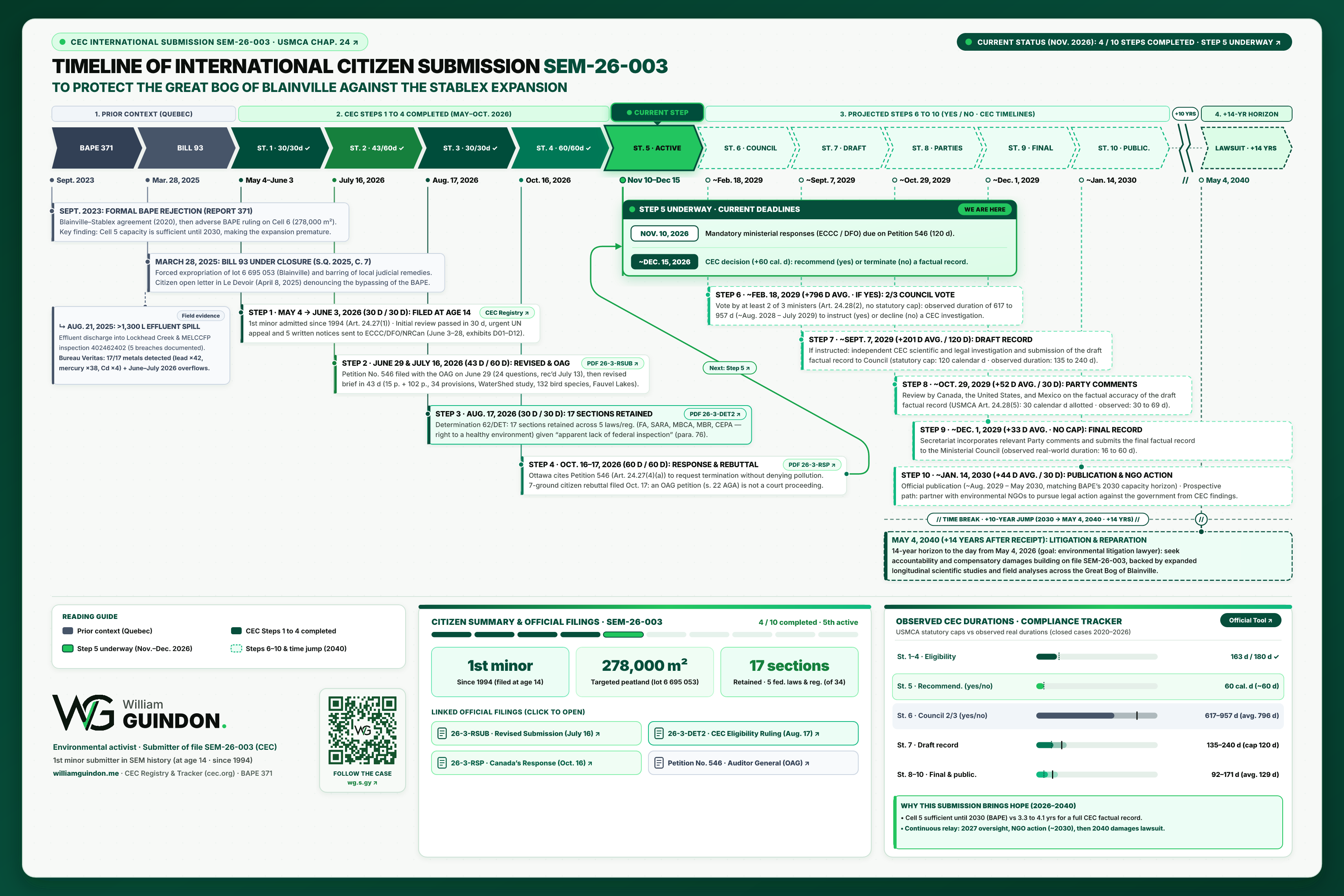
Timeline of the SEM-26-003 International Citizen Recourse
Comprehensive timeline tracing every major milestone: from the formal BAPE rejection (Report 371) and forced municipal expropriation under Bill 93 to the 10 procedural steps of the Canada–United States–Mexico Agreement (USMCA) and projected recourse horizons through 2040.
← Back to primary dossier: Stablex Blainville Pillar Page ↗ · Consult official documents: CEC Documentary Registry ↗
High-Resolution Downloads & Citizen Archiving
Open Access • Zero TrackersThe complete timeline is freely available in high resolution for public archiving, legal research, large-format printing, and investigative reporting:
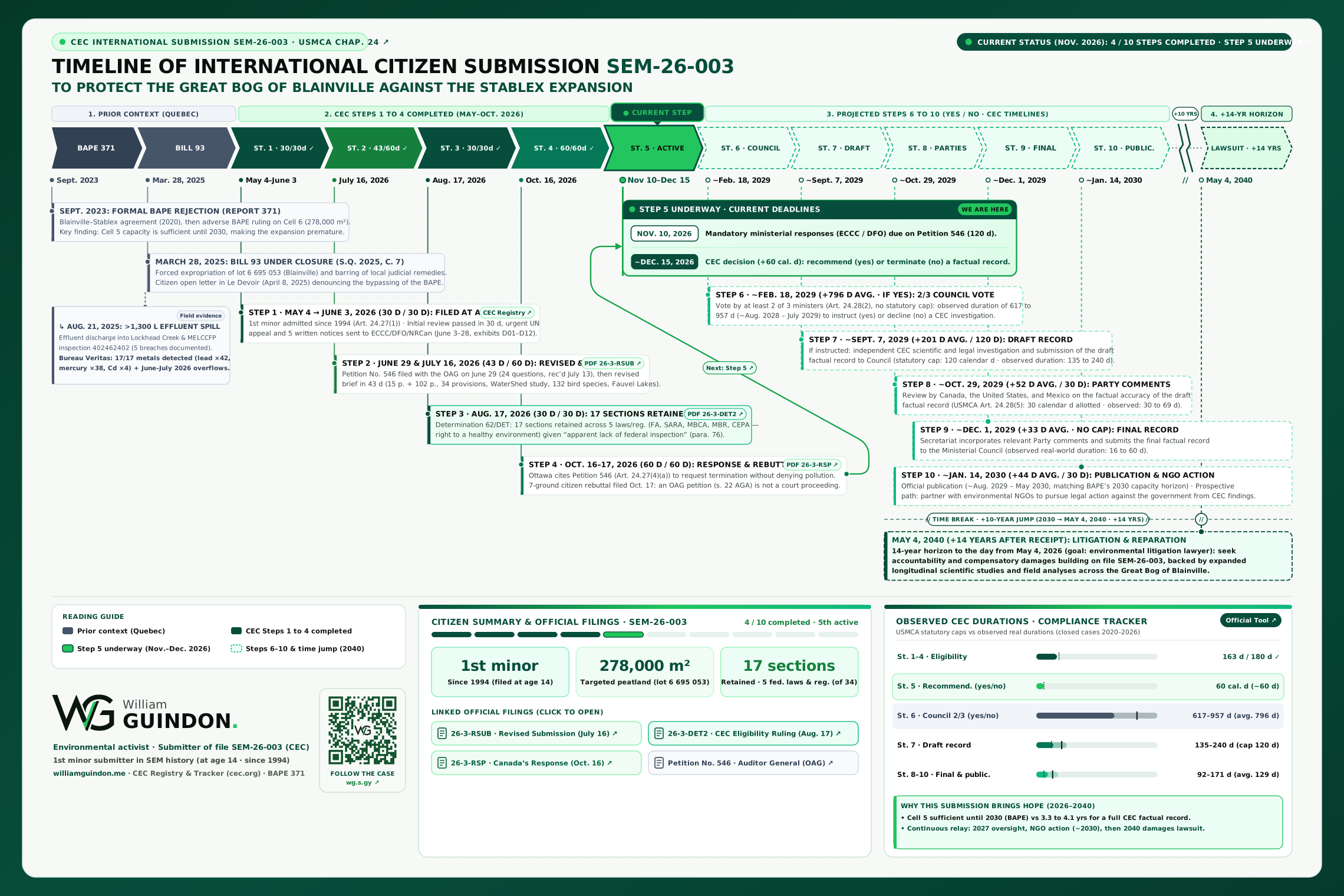
Read detailed analysis of the 10 CUSMA steps and legal background (BAPE 371 & Bill 93) Show analysis ▾
1. Quebec Legislative & Environmental Background: BAPE 371 and Bill 93
The timeline originates from the rigorous scientific rejection of the Cell 6 expansion (278,000 m² of ombrotrophic peatland). BAPE Report 371 documented a decisive factual point: existing Cell 5 possesses sufficient residual disposal capacity until 2030, rendering the premature destruction of the wetland wholly unwarranted.
Faced with the City of Blainville's refusal to cede municipal conservation lands, the Quebec government enacted Bill 93 under gag order, stripping municipal jurisdiction and transferring the land to Stablex, triggering ongoing constitutional litigation before the Quebec Superior Court.
2. The 4 Completed CEC Steps (May to October 2026)
- Step 1 · Preliminary Filing & Acknowledgment (May 4 – June 3, 2026): Initial procedural exchanges and verification under Article 24.27(1).
- Step 2 · Formal Submission of 200+ Pages & 222 Exhibits (July 16, 2026): William Guindon, aged 15, files the comprehensive citizen submission alleging non-enforcement of the Fisheries Act (cadmium discharges exceeding aquatic life benchmarks by up to 320 times) and the Species at Risk Act.
- Step 3 · Positive Determination DET-26-003 (August 17, 2026): Groundbreaking determination finding that the submission meets all strict criteria of Articles 24.27(2) and (3), setting Canada's deadline for October 16, 2026.
- Step 4 · Canada's Response (72-RSP) & Submitter's Legal Rebuttal (Oct. 16–17, 2026): Canada requests dismissal citing the submitter's own petition to the Auditor General. On October 17, William Guindon files observations establishing that an Auditor General petition is not an ongoing judicial or quasi-judicial proceeding under Article 24.27(4)(a).
3. Step 5 Underway: Secretariat Review & Recommendation
Under Article 24.28(1) of the USMCA, the CEC Secretariat has 60 working days to evaluate Canada's response and recommend whether file SEM-26-003 warrants the development of an independent international Factual Record to the CEC Council (environment ministers of Canada, the United States, and Mexico).
Should the Secretariat confirm that key questions remain unanswered by Canada — particularly regarding toxic cadmium percolation and the destruction of critical wetland habitats —, it will formally recommend opening a full international investigation.
4. Projected Steps 6 to 10 and Follow-up Horizon Through 2040
The vector timeline projects realistic historical timelines based on past CEC factual records:
- Step 6 · Council Vote (two-thirds majority): Formally scheduled among the three environment ministers (historical average of 796 calendar days, ranging from 617 to 957 days).
- Step 7 · Preparation of Draft Factual Record: The Secretariat gathers technical evidence, conducts site visits, and drafts the report (average 129 calendar days).
- Steps 8–10 · Party Comments, Final Vote & Public Release: Independent factual findings made publicly accessible across all three nations.
- Horizon 2027–2040 · Continuous Oversight & Compensatory Litigation: Ongoing environmental compliance, NGO litigation around 2030, and remediation oversight through May 2040 (+14 year horizon).